
The Federal Reserve is best known for its interest-rate decisions. But changing its policy rate is not the only way it can influence borrowing costs and financial markets.
During periods of economic or financial stress, the Fed has purchased enormous quantities of Treasury securities and mortgage-backed securities. At other times, it has reduced those holdings, often by allowing securities to mature without replacing them.
These policies are known as quantitative easing (QE) and quantitative tightening (QT). Although they move the Fed’s securities holdings in opposite directions, their effects on bond yields, financial conditions, and asset prices are neither simple nor necessarily symmetrical.
The key to understanding these policies lies in the Federal Reserve’s balance sheet: what it owns, what it owes, and how changes in those positions reach the financial system.
What Is the Fed’s Balance Sheet?
A balance sheet records what an institution owns and what it owes. The Federal Reserve has one, just like a commercial bank, but its role is different: some of its liabilities serve as money used within the banking system.
On the asset side, the Fed primarily holds securities such as U.S. Treasury securities and agency mortgage-backed securities (MBS). It can also hold loans and other assets arising from its operations.
On the liability side are reserve balances held by banks and other eligible institutions, currency in circulation, deposits maintained by the U.S. Treasury, and other obligations.
Why bank reserves matter
Commercial banks hold accounts at the Federal Reserve. The balances in these accounts are called reserves. Banks use them to settle payments with one another and meet liquidity needs. Reserves also play an important role in how the Fed implements monetary policy.
They are not the same as the deposits households hold at commercial banks. A household cannot simply open a reserve account at the Fed.
Suppose the Fed buys $100 million in Treasury securities from an investment fund. The transaction affects three balance sheets: the Fed’s, the investment fund’s, and the commercial bank where the fund holds its deposit. The diagram shows how securities, reserves, and bank deposits change.
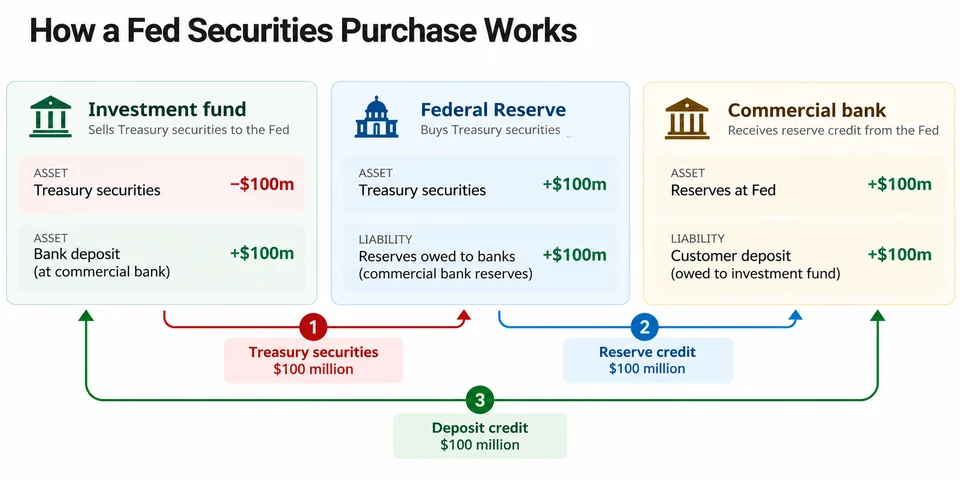
How Quantitative Easing Works
Normally, the Federal Reserve influences monetary conditions primarily by adjusting short-term interest rates. But during a severe economic downturn, those rates can fall close to zero while borrowing conditions remain restrictive.
That was the challenge the Fed faced during the 2008 financial crisis. Lowering its policy rate was no longer enough to provide the additional support it wanted, so the Fed turned to large-scale asset purchases, commonly called quantitative easing, or QE.
Under QE, the Fed buys substantial quantities of securities, typically U.S. Treasuries and agency mortgage-backed securities. These purchases increase the securities held on its balance sheet and generally increase reserve balances, although other balance-sheet changes can affect the net increase.
Creating reserves, however, is not the ultimate objective. QE is intended to ease broader financial conditions, particularly by influencing longer-term borrowing costs.
How buying securities can lower yields
When the Fed purchases substantial quantities of longer-term Treasury securities, private investors are left holding fewer of those securities and less of the interest-rate risk associated with them. Investors may respond by purchasing other bonds and financial assets.
This process can support bond prices and reduce the additional yield investors demand for holding longer-term debt. The mechanism is known as the portfolio-balance channel. Because bond prices and yields move in opposite directions, upward pressure on bond prices can translate into lower yields.
QE can also work through expectations. Large-scale purchases may signal that the Fed intends to maintain accommodative monetary policy for an extended period, although the strength of that signal depends on the circumstances and the Fed’s communication.
Investors may price in purchases before they begin, while other forces can still push yields higher.
Mortgage-Backed Securities in QE
The Fed has purchased large quantities of agency mortgage-backed securities, which are backed by pools of residential mortgages and guaranteed by government-sponsored enterprises or federal agencies.
These purchases can support mortgage-market functioning and put downward pressure on mortgage financing costs. The effect can spread as investors adjust their portfolios, but it is not fixed for each dollar purchased.
How Quantitative Tightening Works
Quantitative easing expands the Federal Reserve’s securities holdings. Quantitative tightening, or QT, moves in the opposite direction by reducing those holdings over time.
The Fed does not necessarily need to sell bonds to shrink its balance sheet. Treasury securities have maturity dates, and when a Treasury security held by the Fed matures, the Treasury repays its principal. The Fed can maintain its holdings by arranging to replace maturing securities with newly issued ones. During QT, it instead allows some or all of those securities to mature without replacement. This is called balance-sheet runoff.
How runoff reduces the balance sheet
Suppose the Fed holds $100 billion in Treasury securities scheduled to mature over a particular period. If it replaces the full principal amount, its Treasury holdings remain broadly unchanged, assuming no other transactions. If it replaces only $60 billion, its Treasury holdings decline by $40 billion.
The Fed has generally managed runoff using monthly caps that limit how much principal can go unreinvested. If scheduled repayments exceed the applicable cap, the Fed reinvests the excess.
Agency mortgage-backed securities introduce another complication: homeowners can repay mortgages early, so the timing of principal payments is less predictable than the maturity schedule of conventional Treasury securities.
Runoff therefore allows the Fed to shrink its portfolio without regularly selling bonds in the market.
What happens to bank reserves?
When a Treasury security held by the Fed matures, the Treasury repays the principal from its account at the Fed. The Fed’s Treasury holdings decline, and the Treasury’s account balance falls by the same amount at settlement.
That settlement does not automatically reduce bank reserves: the payment comes from the Treasury’s account at the Fed. Reserves can change earlier, as the Treasury collects taxes or raises funds, and later, as it spends. Other Fed liabilities, including currency and reverse repurchase balances, can also shift.
Over time, QT generally leaves fewer reserves or other Fed liabilities than there would have been without runoff. But a $40 billion decline in securities holdings does not necessarily mean a $40 billion fall in reserves. That is why the Fed monitors reserve conditions alongside its portfolio.
Why QT is not simply QE in reverse
QE and QT change the size and composition of the Fed’s securities portfolio in opposite directions. Their effects on markets, however, need not be symmetrical.
QE has often been introduced during periods of severe economic or financial stress, when the Fed wanted to provide substantial additional accommodation. Announcements of large purchases could therefore carry significant information about the future policy outlook.
QT has generally followed announced runoff plans, giving investors time to adjust. As Fed holdings decline, other investors must absorb more Treasury debt than they otherwise would. That can put upward pressure on longer-term yields, although it is difficult to isolate QT’s effect from other influences.
QT also interacts with the level and distribution of reserves in the banking system. When reserves are plentiful, a gradual reduction may have little immediate effect on short-term funding markets. As reserves become less abundant, further reductions can have greater consequences for market functioning.
How QE and QT Reach Financial Markets
The Federal Reserve does not buy stocks as part of its regular quantitative easing programs. Nor does it directly set the yields on long-term Treasury bonds or corporate debt. Yet balance-sheet policy can influence these markets through borrowing costs, investor portfolios, and financial conditions.
Borrowing costs beyond Treasuries
Treasury yields serve as important benchmarks for other interest rates. Corporate bond yields, mortgage rates, and other financing costs often reflect Treasury yields plus additional compensation for credit risk, liquidity, or other factors.
When QE puts downward pressure on longer-term Treasury yields, some of that influence may extend to private borrowing costs. Purchases of agency mortgage-backed securities can also affect mortgage financing more directly.
QT may put upward pressure on borrowing costs, but Treasury issuance, investor demand, inflation expectations, and credit spreads also matter. A shrinking Fed balance sheet does not guarantee higher borrowing costs.
Stock valuations and investor risk appetite
Stocks can respond to balance-sheet policy even though they are not the securities the Fed is purchasing.
One connection is through discount rates. Lower longer-term interest rates can increase the present value investors assign to future corporate earnings, all else equal. Another involves portfolio decisions: investors facing lower yields on relatively safe securities may become more willing to hold assets with greater risk.
QE can therefore support equity valuations through changes in financing conditions and investor preferences. But if the Fed introduces QE during a severe recession, deteriorating earnings expectations may overwhelm the benefit of lower discount rates.
Stocks can also rise during QT if earnings and economic conditions outweigh the effect of runoff.
Short-term funding conditions
Balance-sheet policy can also affect markets where financial institutions borrow and lend over short periods.
Banks use reserves to settle payments and manage liquidity. When reserves are abundant, a moderate decline may have little effect on overnight rates. If reserves become scarce or are concentrated in a few institutions, further declines can put pressure on short-term funding markets. The Fed monitors those markets because runoff alone cannot show whether funding conditions are becoming strained.
Why Not Every Balance-Sheet Change Is QE or QT
A growing Federal Reserve balance sheet is often described as money printing or quantitative easing. A declining balance sheet is sometimes taken as evidence that the Fed is tightening monetary policy.
Neither interpretation is necessarily correct. The Fed’s balance sheet changes for several reasons: some operations are designed to influence broader financial conditions, while others support market functioning or the implementation of monetary policy. The purpose of an operation matters as much as the amount involved.
Reserve management is not necessarily quantitative easing
Maintaining an adequate supply of bank reserves helps the Fed keep short-term interest rates within its intended range.
As currency in circulation and other Federal Reserve liabilities change, the Fed may need to adjust its assets to maintain sufficient reserves. It can purchase securities for this purpose without intending to push down longer-term yields or provide the broad monetary accommodation associated with QE. These operations are generally described as reserve-management purchases.
Both QE and reserve-management purchases can expand the Fed’s balance sheet, but their objectives differ. QE aims to ease broader financial conditions, while reserve-management purchases primarily support the effective implementation of interest-rate policy.
Emergency lending can also expand the balance sheet
The Fed can lend to eligible financial institutions through facilities designed to provide liquidity when funding markets face stress.
Such lending increases the Fed’s assets, but it is not necessarily quantitative easing. During a banking or financial disruption, the Fed might provide substantial short-term funding while maintaining a restrictive interest-rate policy.
When those loans are repaid, the Fed’s assets can decline even if it has not initiated a QT program.
What Traders Should Watch
When the Fed announces a change in its balance-sheet policy, the headline often focuses on the amount of securities it plans to buy or allow to mature. That number matters, but traders need to distinguish the announced policy from the transactions that follow.
The announced plan
During QE, the size, duration, and composition of purchases help indicate the scale of the intended intervention.
During QT, runoff caps and reinvestment rules help determine how quickly the portfolio can shrink. Actual reductions may be smaller than the caps when principal repayments are insufficient to reach them.
Changes in these plans can affect expectations before the Fed carries out the transactions. The reason for a change also matters: slower runoff may reflect an adjustment to reserve conditions rather than a decision to stimulate the economy.
What actually happens to the balance sheet
The Fed publishes a weekly report known as H.4.1, which provides data on securities holdings, reserve balances, and other assets and liabilities. Comparing successive reports helps distinguish announced policy from actual changes in the Fed’s accounts.
Compare securities holdings with reserves and the Treasury’s account. If they move by different amounts, other Fed liabilities may help explain why.
What funding markets are showing
Traders following QT can also examine short-term funding conditions. The Secured Overnight Financing Rate (SOFR), repo-market conditions, and the relationship between overnight market rates and the Fed’s administered rates may provide clues about funding pressures.
A one-day spike does not prove reserves are scarce. Treasury settlements and quarter-end pressures can also move funding rates, so look for a persistent pattern across measures.
The Federal Open Market Committee’s statements and implementation plans explain what the Fed intends to do. The Federal Reserve Bank of New York provides information about open-market operations, while H.4.1 reports what has changed on the balance sheet.