
Suppose you see a headline saying markets are pricing in an 80% probability of a Federal Reserve rate cut at the next meeting. Where does that number come from? And how can anyone assign a probability to a decision the Fed hasn't made yet?
These figures appear regularly in financial news, sometimes changing considerably before a Fed meeting. Yet they are not official Fed forecasts, and even a high probability doesn't guarantee a rate cut.
Behind that seemingly precise number lies a market-based calculation, one that depends on how traders price future interest rates.
How Federal Funds Futures Reflect Rate Expectations
Federal funds futures are exchange-traded contracts tied to the effective federal funds rate, the rate at which eligible institutions actually lend federal funds overnight. Although closely related to the Fed's target range, the effective rate is a market rate rather than the target itself.
Each futures contract covers a particular calendar month. Its price implies a monthly average effective federal funds rate, using a quotation convention that subtracts the rate from 100.
For example, suppose a federal funds futures contract trades at 95.75.
100 − 95.75 = 4.25%
That price implies an average effective federal funds rate of approximately 4.25% for the contract month. The relationship works in reverse: when the expected rate falls, the futures price rises, and vice versa.
Why the Timing of a Fed Meeting Matters
A futures contract reflects the average rate across an entire month, not necessarily the rate expected immediately after an FOMC meeting. Suppose the effective federal funds rate is 4.50% at the beginning of a 30-day month. The Fed meets halfway through that month and cuts rates by 0.25 percentage points, bringing the effective rate to approximately 4.25%.
If the old rate applies for 15 days and the new rate for the remaining 15 days, the monthly average would be:
(4.50% × 15 + 4.25% × 15) ÷ 30 = 4.375%
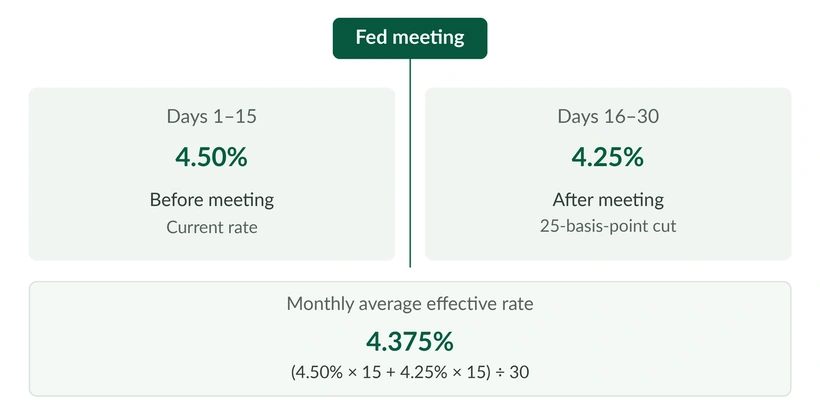
The corresponding futures price would be approximately 95.625, even though the rate following the meeting is 4.25%. To estimate probabilities for different Fed decisions, analysts account for meeting dates, expected rates before and after meetings, and prices of other contract months.
How to Read CME FedWatch Probabilities
The CME FedWatch Tool uses federal funds futures prices to estimate probabilities for possible Fed target-rate outcomes at upcoming FOMC meetings.
Reading the Probabilities
Suppose FedWatch displays the following probabilities for the next meeting:
| Possible decision | Implied probability |
|---|---|
| Cut rates by 0.25 percentage points | 80% |
| Leave rates unchanged | 20% |
These figures suggest that market pricing favors a quarter-point cut. They do not mean that 80% of traders expect a cut, nor that the Fed assigns an 80% probability to that outcome.
How Futures Prices Become Probabilities
Consider a simplified example in which the market is pricing only two possible outcomes: no rate change or a 0.25-percentage-point cut.
Suppose the effective federal funds rate before the meeting is 4.50%, and futures pricing implies an expected post-meeting rate of 4.30%.
The expected decline is 0.20 percentage points, or 20 basis points. Under the two-outcome assumption:
20 basis points ÷ 25 basis points = 80%
That produces an implied probability of 80% for a quarter-point cut and 20% for no change.
The probability-weighted average of the possible rates is 4.30%:
- 80% × 4.25% = 3.40%
- 20% × 4.50% = 0.90%
- Combined expected rate = 4.30%
In practice, CME FedWatch uses futures prices and meeting-date adjustments to infer the relevant rates. It also assumes rate changes occur in 25-basis-point increments and that the effective federal funds rate responds proportionally. Our simplified calculation illustrates the principle rather than reproducing every step of CME's methodology.
Reading Expectations for Later Meetings
FedWatch also displays probabilities for meetings further into the future. These describe the likelihood of reaching particular target-rate ranges by those meetings, accounting for possible decisions at preceding meetings.
For example, a probability assigned to a lower target range at the third upcoming meeting does not necessarily mean the entire reduction will happen at that meeting. Some of it may be expected at the first or second meeting.
What Market-Implied Probabilities Cannot Tell You
Consider the earlier example in which futures pricing implied a 20-basis-point reduction. We interpreted it as an 80% probability of a 25-basis-point cut because we assumed only two possible outcomes.
But different combinations of possible rate changes could produce the same expected reduction. Futures prices alone do not reveal exactly how traders assign probabilities to every conceivable outcome.
Market Pricing Is Not a Survey of Beliefs
Futures prices emerge from trading rather than a direct survey of investors' expectations. Some market participants trade to express a view about future interest rates. Others use futures to hedge existing exposures or manage financial risks. Prices can therefore reflect risk premiums and other trading influences alongside expectations.
Market-implied probabilities should not automatically be treated as objective probabilities of what the Fed will do. They also provide little explanation of why a particular outcome is being priced. Similar implied probabilities at different times may reflect very different economic circumstances.