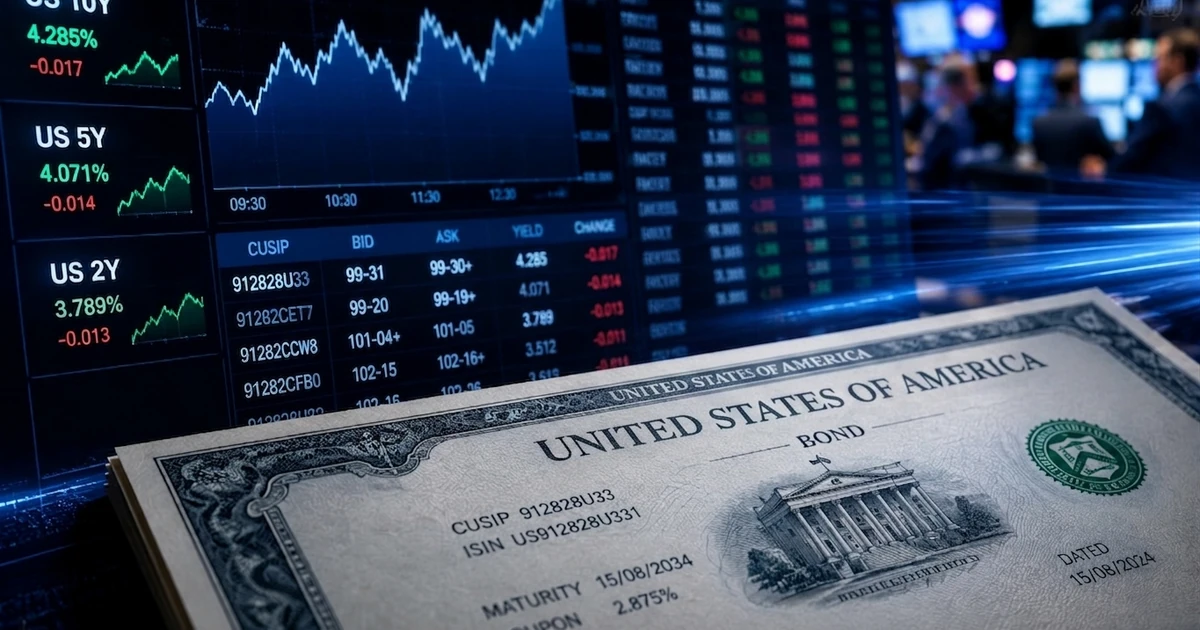
In 1975, getting into the bond market looked very different from today. Much of the market was dealer-driven, price information was far less transparent, and individual investors had fewer practical ways to build broad bond exposure. Even Treasury minimums could be substantial: Treasury bills commonly required investments of $10,000, while minimum denominations for notes and bonds varied by issue.
Today, you can gain broad exposure to the U.S. bond market in minutes, often from a phone and with a relatively small amount of money.
That change is one of the quieter revolutions in modern finance. Exchange-traded funds, electronic trading platforms, and derivatives markets have made bond exposure far easier to access.
1.Individual Bonds — The Direct Route
Trading individual bonds means buying and selling the securities themselves.
U.S. Treasury securities can be purchased directly from the government through TreasuryDirect or through banks and brokerage firms. TreasuryDirect allows individuals to participate in Treasury auctions with a minimum purchase of $100, and there is no fee to open or manage the account.
TreasuryDirect is designed primarily for holding securities rather than actively trading them. If you want to sell a Treasury held there before maturity, you must first transfer it to a bank, broker, or dealer that can execute the sale in the secondary market.
Corporate and municipal bonds are typically bought and sold through brokerage firms. Unlike stocks, most of these bonds trade over the counter, through brokers and dealers rather than on a single centralized exchange.
That means there may not be one visible market price for every bond. A bond can have a bid, the price at which someone is willing to buy it, and an ask, the price at which it is offered for sale. The difference is the bid-ask spread, one potential cost of entering or exiting the position. Dealer compensation can also be built into the transaction through a markup when a dealer sells a bond from its inventory or a markdown when it buys one from a customer.
For many corporate bonds, investors can also check recent transactions through FINRA’s TRACE system. TRACE publishes information such as trade prices and transaction sizes for eligible fixed-income securities, providing useful context when evaluating a quoted price.
Liquidity can still vary substantially from one bond to another. Frequently traded securities may have narrow spreads and many available buyers and sellers, while a less active corporate or municipal bond may trade only occasionally. If you sell before maturity, that liquidity, together with changes in interest rates, credit conditions, and investor demand, can affect the price you receive.
2.Bond ETFs — An Easy Entry Point
Bond ETFs make it relatively simple for individual investors to access the bond market, and the trading experience is much closer to trading a stock.
The ETF itself holds a portfolio of securities. Depending on the fund, those holdings might include Treasuries, investment-grade corporate bonds, high-yield bonds, inflation-protected securities, or a broader mix. A single ETF can therefore provide exposure to many bonds through one trade. The bonds inside the fund continue to generate interest, and bond ETFs commonly pass much of that income to shareholders through distributions.
A conventional bond ETF has no single maturity date. Individual bonds inside the portfolio mature or are sold and replaced while the fund continues operating. ETF shares can also trade slightly above or below the value of the underlying portfolio, creating a premium or discount to net asset value, or NAV. Investors also face the ETF’s bid-ask spread when buying or selling shares.
Some widely used bond ETFs include:
- TLT (iShares 20+ Year Treasury Bond ETF) — provides exposure to long-term U.S. Treasury bonds and is highly sensitive to changes in long-term interest rates.
- BND (Vanguard Total Bond Market ETF) — provides broad exposure to the U.S. investment-grade bond market, including Treasuries, corporate bonds, agency securities, and mortgage-backed securities.
- HYG (iShares iBoxx $ High Yield Corporate Bond ETF) — provides exposure to below-investment-grade corporate bonds, bringing higher credit risk than investment-grade bond funds.
- TIP (iShares TIPS Bond ETF) — holds Treasury Inflation-Protected Securities, providing exposure to U.S. government bonds whose principal adjusts with inflation.
3.Bond Futures — The Professional’s Instrument
Bond futures are standardized contracts linked to U.S. Treasury securities for settlement at a future date. A trader expecting Treasury prices to rise can take a long position, while someone expecting prices to fall can take a short position. Institutions also use futures to adjust or hedge interest-rate exposure.
Treasury futures trade on the Chicago Board of Trade (CBOT), part of CME Group, and are among the most actively traded interest-rate futures in the world.
Common contracts include:
Treasury Note Futures (2-year, 5-year, and 10-year) provide exposure to different parts of the Treasury yield curve. The 10-year Treasury futures contract is particularly important and is widely used by traders and institutions to express views on interest-rate movements.
Treasury Bond Futures provide exposure to longer-term Treasury securities and are commonly used to trade or hedge long-duration interest-rate risk.
What makes futures different:
Leverage. A standard 10-year Treasury futures contract has a face amount of $100,000, but the trader posts only a fraction of that amount as margin. This leverage can magnify both gains and losses.
Mark-to-market. Futures positions are settled daily. If the position moves against you, losses are debited from the account; if it moves in your favor, gains are credited. Adverse moves can also require additional margin.
No coupon income. The futures contract itself does not pay coupon income. Profit or loss comes from changes in the contract’s value, and most positions are closed or rolled before delivery.
Futures are primarily used by institutional traders, hedge funds, and experienced retail traders. For beginners, the leverage, complexity, and margin requirements generally make them a more advanced way to trade the bond market.
A Brief Note on CFDs
In some non-U.S. markets, retail traders can also gain exposure to the bond market through contracts for difference, or CFDs.
CFDs allow traders to speculate on bond price movements without owning the underlying bond. You open a position, and your profit or loss is based on the difference between the opening and closing price, multiplied by your position size.
CFDs can provide leverage, which can magnify both gains and losses. They can also involve financing costs and counterparty risk. CFD availability and regulatory protections vary by jurisdiction, and they are generally not available to U.S. retail customers through U.S.-regulated brokers.
For that reason, CFDs are better treated as a specialized form of leveraged bond exposure rather than a core route into the bond market.
A Practical Comparison
| Instrument | Where It Trades | What You Own or Trade | Maturity or Expiry | Leverage | Typical Use |
|---|---|---|---|---|---|
| Individual bond | Broker/dealer network | A specific bond | Stated maturity | Not inherent | Holding or trading a specific bond |
| Bond ETF | Stock exchange | Shares of a bond fund | No single maturity | Not inherent | Easily traded diversified bond exposure |
| Treasury futures | Futures exchange | A derivative contract | Contract expires | Yes, via margin | Trading or hedging interest-rate exposure |
Choose the Instrument Before You Trade
The same bond-market view can often be expressed through more than one instrument.
An investor expecting Treasury prices to rise might buy an individual Treasury, buy shares of a Treasury ETF, or take a long Treasury futures position. The direction of the market view may be the same, but the cash flows, liquidity, maturity, and leverage are not.
Before placing the trade, decide whether the objective is direct bond ownership, easily traded diversified exposure, or leveraged interest-rate exposure. The instrument should match the type of exposure you actually want.
Sources and Further Reading
- U.S. Treasury / FRASER — Press Releases of the United States Department of the Treasury, 1975
- FINRA — What Is TRACE and How Can It Help Me?
- FINRA — Bonds
- FINRA — Bond Liquidity: Factors to Consider and Questions to Ask
- U.S. Treasury / TreasuryDirect — Selling a Treasury Marketable Security
- U.S. Securities and Exchange Commission / Investor.gov — Updated Investor Bulletin: Exchange-Traded Funds (ETFs)
- CME Group — The Basics of U.S. Treasury Futures
- CFTC / SEC — Further Definition of “Swap,” “Security-Based Swap,” and “Security-Based Swap Agreement”; Mixed Swaps; Security-Based Swap Agreement Recordkeeping