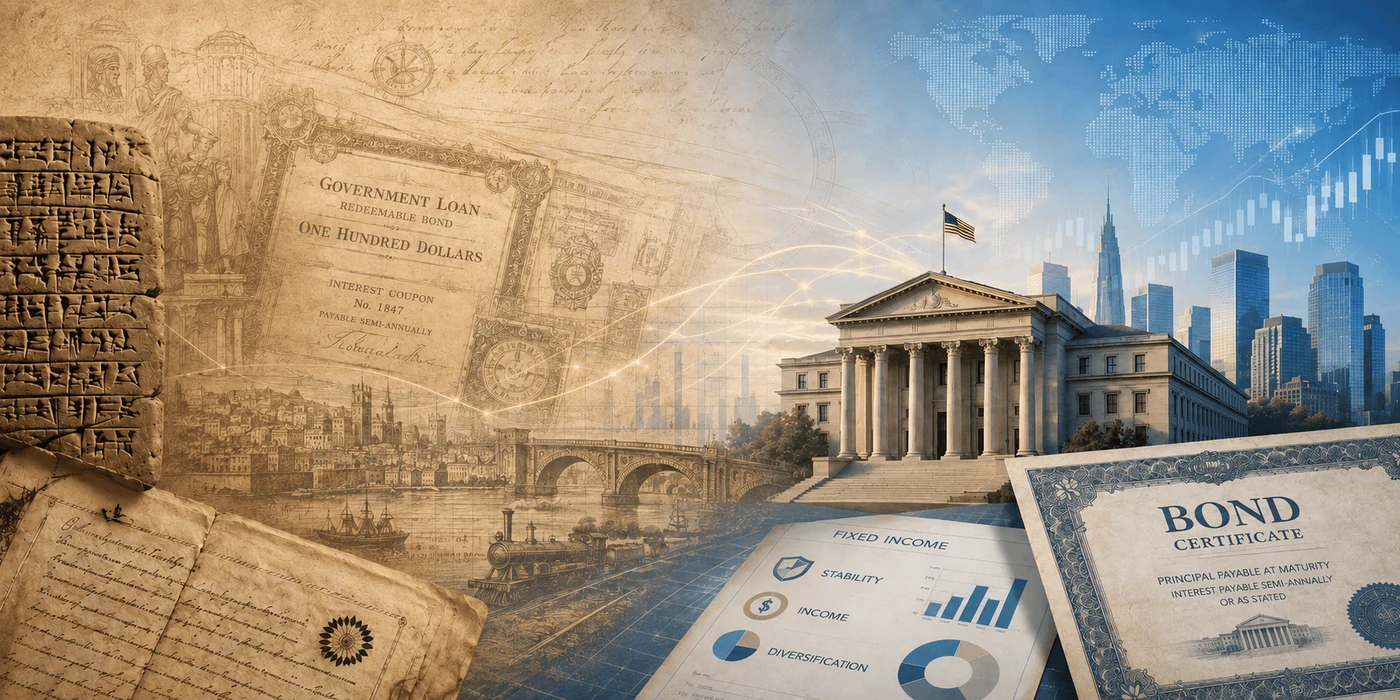
Long before stock markets existed, before central banks, before any of the financial machinery we take for granted today, there were bonds.
The earliest known evidence of a bond-like agreement dates to Nippur, in modern-day Iraq, nearly 4,400 years ago—a clay tablet recording a future payment obligation involving grain. Forms of government debt much closer to modern bonds took another three and a half thousand years to emerge, first in medieval Genoa and then Venice, where governments raised money from citizens and investors. The Dutch Republic took the idea much further in the 1600s, building one of the world’s most sophisticated markets for public debt. One bond from that era, issued in 1648 by a Dutch water board to finance work on a dike system, still pays interest today.
The concept has survived empires, wars, and financial crises. That staying power says something important: lending money through a formal contract is one of the most fundamentally useful ideas humans have ever come up with.
Start With Something You Already Understand
Imagine your friend needs $1,000 to start a small business. You do not want to become a co-owner. That is too much risk and too much involvement. You just want your money back, with a little extra for the years you went without it.
So you agree on terms. You lend $1,000. They pay you $50 a year. In five years, you get the full $1,000 back.
That is the basic structure of a bond.
Now scale it up. Instead of your friend, the borrower is the U.S. government, Apple Inc., or the city of Chicago. Instead of a handshake, the terms are set out in a formal debt security that can often be bought and sold in financial markets. The numbers get larger. The mechanics get more formal. But the core idea—lending money in exchange for promised payments—stays the same.
Why Do Organizations Borrow This Way?
One important answer is scale.
When the U.S. government needed enormous amounts of financing during World War II, it sold war bonds broadly to the public. Between 1941 and 1945, Americans purchased more than $185 billion in war bonds. Millions of ordinary people participated, turning government borrowing into a genuine mass financial mobilization.
The same basic idea applies to companies. When Apple issued $17 billion in bonds in 2013—at the time the largest non-bank bond deal on record—it did not need a single lender willing to provide the entire amount. The bond market allowed the company to borrow from a large pool of investors, each buying a portion of the debt.
That ability to raise large amounts of money from many investors is one reason bond markets matter so much. And the market itself is enormous: global fixed-income securities outstanding run into well over $100 trillion, making bonds one of the largest financial markets in the world.
The Four Terms You Actually Need
Face Value is the amount the borrower promises to repay when the bond matures. It is also called par value. A $1,000 face value is common in many U.S. bond examples, although denominations vary by security and market. What you pay for a bond in the market may differ from this number, but face value is the amount scheduled to be repaid at maturity.
Coupon Rate is the annual interest rate stated on a traditional fixed-rate bond, expressed as a percentage of face value. A 5% coupon on a $1,000 bond means $50 per year, often paid in two $25 installments every six months.
The word coupon comes from the days when bonds were physical paper certificates with small detachable coupons attached, one for each payment date. Investors would literally clip the coupon and present it to collect their interest. Wall Street’s phrase “clipping coupons” comes directly from this practice.
Maturity Date is when the bond reaches the end of its stated term and the face value is scheduled to be repaid. Bonds can mature in weeks, months, years, or decades. The U.S. Treasury, for example, issues securities across a wide range of maturities.
The Issuer is whoever borrowed the money, and it matters enormously because the issuer helps determine the credit risk. U.S. Treasury securities are backed by the full faith and credit of the U.S. government and are generally treated as carrying extremely low default risk. But that does not make them free from risks such as inflation or changes in market interest rates.
A financially weak company carries more credit risk, so its bonds generally need to offer a higher yield than comparable Treasuries.
How the Money Actually Flows
A concrete example makes this real.
Say the U.S. Treasury issues a 10-year bond with a face value of $1,000 and a coupon rate of 4.5%, and you buy it at face value. The timeline below shows how the scheduled payments unfold over the life of the bond.

What matters here is the schedule. Assuming the issuer makes its payments as promised, you know when the coupons are due and when the principal is scheduled to return.
That predictability is one reason bonds are useful to pension funds and insurance companies. Both may have payments they expect to make years into the future, so assets with defined cash-flow schedules can help them plan for those obligations.
Bonds vs. Stocks: The Real Difference
When you buy a stock, you own a piece of a company. If the business does well, you can share in the upside. If it fails, you can lose your entire investment. There is no contractual promise that shareholders will receive a particular payment.
When you buy a corporate bond, you are a creditor, not an owner. You have a contractual claim on the company. If the company goes bankrupt, bondholders generally rank ahead of common stockholders, although different types of debt can have different levels of priority.
That distinction mattered when Lehman Brothers collapsed in 2008. Shareholders were effectively wiped out, while creditors recovered at least part of what they were owed. At the time of Lehman’s bankruptcy filing, prices of its senior bonds implied a recovery rate of about 30%, although actual recoveries varied across creditor groups as the bankruptcy unfolded.
The tradeoff is straightforward. Stocks offer ownership and open-ended upside. Bonds give up that ownership in exchange for a contractual claim on specified payments.
Key Takeaways
- Bonds grow out of one of finance’s oldest ideas: lending money under agreed terms.
- A bond is a debt security: you lend money to an issuer in exchange for promised payments and scheduled repayment of principal according to the bond’s terms.
- Four terms matter immediately: face value, coupon rate, maturity date, and issuer.
- Traditional fixed-rate bonds can provide a defined schedule of payments, but that does not make the investment risk-free.
- Bondholders are creditors rather than owners, and debt claims generally rank ahead of common stock, although different creditor classes can have different priority and recovery.
- The bond market is enormous, with global fixed-income securities outstanding totaling $145.1 trillion in 2024.
Sources & Further Reading
- Yale School of Management — Prof. Goetzmann Discusses Finance Practices in Mesopotamia
https://som.yale.edu/story/2023/prof-goetzmann-discusses-finance-practices-mesopotamia
- Michele Fratianni & Franco Spinelli — Italian City-States and Financial Evolution
https://doi.org/10.1017/S1361491606001754
- YaleNews — Yale’s 367-Year-Old Water Bond Still Pays Interest
- United States Holocaust Memorial Museum — War Bonds
https://collections.ushmm.org/search/catalog/irn520972
- Reuters — Apple Wows Market With Record $17 Billion Bond Deal
- SIFMA — 2025 Capital Markets Fact Book
https://www.sifma.org/research/statistics/fact-book
- FINRA — What a Corporate Bankruptcy Means for Shareholders
https://www.finra.org/investors/insights/what-corporate-bankruptcy-means-shareholders
- Federal Reserve Bank of New York — Creditor Recovery in Lehman’s Bankruptcy
https://libertystreeteconomics.newyorkfed.org/2019/01/creditor-recovery-in-lehmans-bankruptcy/